~*~*~*~*~
Day 7: Tel Aviv.
Part 1: Boker tov-ing to HamBoker.
I decide to go with the “Best Brunch Restaurant” recommendation that I read about the night before in the latest version of the Time Out Tel Aviv magazine [English edition]. Though Gili’s at the Tel Aviv Port sounds really tempting – the steak I had there in September was very tasty – I decide to try something new. I end up cabbing over to Benedict, where brunch food is served at all hours of the day. There are two locations of Benedict, and I go to the location at Rothschild & Allenby because it’s closer to where I will be hanging out. The line is crazy long at 11 am, but my solo presence allows for me to skip ahead of other couples / groups.
I order a coffee, crack open a newspaper handed to me by the Jewish-British couple sitting next to me, and catch up on the at-the-time bombing of the UN warehouse in Gaza and pending ceasefire negotiations. It’s good to know that Ban Gi Moon is in Israel to help see this conflict put to rest.
I have a great morning socializing with my spunky waitress while
 nibbling (more like devouring) my HamBoker. It’s a spin off of an American hamburger in name only*, not so much in the ingredients nor the way in which it is served. I have been to a lot of brunch places in Chicago and SF, but I think Benedict has now trumped the others and is my new favorite brunch place.
*Boker tov means “good morning” in Hebrew.
Part 2: Arts & Crafts Market.
As many of you know, I love crafts. So naturally, I hit up the arts and crafts fair at Nakhalat Binyamin, which I missed the last time I was in Israel because it is only open on Tuesdays and Fridays. I wait for my coworker, who is meeting up with me to peruse the artisans’ stalls.
We begin the slow walk through the different stalls. Towards the end, I find items that I like. I end up getting a few postcards from a local photographer because the pri
 nts are too large for my luggage. I also find a birthday present for a friend and a cool bracelet for myself. Following the normal and expected Middle Eastern custom, I negotiate with the craftsman. But a part of me feels bad. The craftsman gives me a small discount of 10 NIS, which is < $3, but I don’t push it. Both of the pieces I select are unique and handmade, and I know this same stuff would cost at least 30-40% more in the States at a trendy boutique. Speaking of crafts…I can’t wait to sign up for more classes in SF.
Part 3: Sheinkin.
My coworker and I wander a few blocks over to Sheinkin, where the vibe is very similar to that of my neighborhood in SF. We pop into a couple of stores, and I end up going again into the store called Scoop. This time, I find a really cute skirt and luckily they’re having a sale, so I end up getting two different colors of the same design. I know that what seems cool or stylish in one country might not be the case in another, but I feel like these skirts are okay to wear (all the while maintaining a bit of a unique, international flavor).
Sababa. “Cool” in Arabic.
Part 4: Neve Tsedek.
My coworker heads home, and I decide to go on a long walk. It’s mid-afternoon, and I know that all the stores and businesses will soon be closing for the start of the Sabbath. The weather is absolutely beautiful – around 70-75 degrees with a soft, cool breeze, which is especially refreshing by the beachfront.
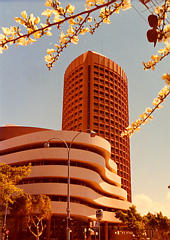
I decide to walk through the fruit and veggie stands of Ha-Karmel (Carmel Market) on my way to Neve Tsedek, the oldest quarter in Tel Aviv that has a charm of its own. The Arabic-style homes in Neve Tsedek contrast to the Bauhaus architecture that give Tel Aviv the reputation as a “white city.” Along the way to Neve Tsedek, I pass by the Intercontinental David Hotel, which towers over Hasan Bek Mosque. I see the beach nearby, so I decide to stroll over for an enjoyable detour.
Here are some pics I took during the day and of my walk:
Part 5: Dinner with the locals.
After Neve Tsedek, I head back to the hotel to relax and rest up my sleep deprived self before heading out to a dinner party with a few of my co-workers. I am invited to my coworker’s for a dinner at 9 pm, not too late by Tel Avivan standards. I walk from my hotel to my coworker’s apartment on Ibn Gabirol near the Museum of Art. I take my humble bottle of Saslove red wine that I bought earlier in the week. Humble because it just doesn’t compare with the South African wine that we have with our South American meal prepared by the girl from Uruguay.
Uruguay, Russia, the U.S., the U.K., Yemen, Israel represented at the Ikea table. We wrap up dinner with a chocolate dessert prepared in a poyke and some sort of bread (maybe banana nut?). Both desserts are prepared by my male coworkers, and I am honestly impressed with their baking skills. The men in my family have never baked or really cooked anything, so it’s a bit foreign to me. Yet, I find foreign to be really nice.
Day 8: The Galilee.
Part 1: The Croat.
It’s early morning. The tour group drives to northern Israel (the Galilee region) along the West Bank border, and we pass by an Arab community. Our guide tells us that the only people required to serve in the military in Israel are the Jewish and Druze communities. Others, including Arabs, are exempt.
I am sitting next to a young (quite attractive I must say) guy from Croatia. He is in Tel Aviv for work as are most foreigners. The only words I can understand are “traffic signals,” but looking at him in his Euro-trendy clothes, I figure he’s a civil engineer and less likely a guy in construction. Mario doesn’t know a lot of English, so for the most part of the ride, we remain silent.
We drive by the kibbutz located at the bottom of a large hill. The kibbutz is known for raising a pig farm, which serves the Christian community in Israel and the U.S. military fleet stationed in the Middle East. We drive up the hill and arrive in Nazareth. Mario and I get off the bus and walk side by side up to the Church of the Annunciation and the Church of Saint Joseph’s Carpentry along with his Croatian coworkers and the others in the tour group. I sort of point at his coworker and communicate with hand gestures that he is extremely tall. I am just a little taller than his coworker’s elbow. Mario says “normal in Croatia,” and I am stunned.
The rest of our day, Mario and I communicate through unspoken friendliness and gestures.
Part 2: Holy Sites.
Regardless of whether you are religious, Israel has a lot of holy sites that are worth visiting. Religion (Jewish, Muslim, Christian / Catholic) is obviously a large part of Israel’s history and culture, but I don’t think you need to understand it to know or appreciate the holy land. I have met many travelers visiting Israel just because. I hope one day you come to Israel to see the country and holy sites for yourself, but in case you don’t get that opportunity, here are some pictures:
Part 3: The Nigerian Man.
A Nigerian man approaches me as I am wandering in the courtyard of the Church of the Annunciation in Nazareth. He asks if I am Korean, sharing that he had seen me take a picture of the mosaic that was sent on behalf of the Christian Church in Korea. The Korean mosaic is one of many mosaics donated to the Church of the Annunciation by countries that have Christian followers. The mosaics are on display along the circumference of the courtyard, the same courtyard in which Mary was visited and told by the angel that she would bear a son named Emmanuel (Jesus).
The man of about 40 years of age shares that he and the Nigerians with him are on pilgrimage to the holy land. Interesting. I didn’t realize that Christianity was that prominant in Nigeria. He comes over to me just to wish me well on my journey, engulfs my left hand in both of his, and says, “Sister, God bless you.”
As we sit in the pews at the Church of the Annunciation, I can’t help but notice the Nigerians who are fervently praying. I honestly haven’t seen anything like that, even at the churches I have attended in the United States. It’s a unique experience and a mental image I plan to carry with me, along with the Nigerian man’s unexpected warm-hearted blessing.
Part 4: The Man I Mistake as a Priest.
We go to the Jordan River to the site where Jesus was baptized. Many Christian and Catholic believers come from all over the world to be baptized at this same site. The woman from Minnesota asks if I want my picture taken and says I should let the man from Mexico bless me with the holy water. So I do.
He and I crouch down, and he blesses me in Spanish in the name of the Father, Son, and Holy Spirit. I ask him if he’s a priest, and he smiles and explains that Catholics can bless others without being a priest. Oh right, woops. He says he works for an Israeli company, and I ditto him and tell him where I work. Ironically, he says he had recently interviewed for my company for the LATAM VP position that I actually support now. Small world, huh?
I still can’t believe that I was blessed by a man who could’ve potentially been someone with whom I work.

Part 5: The Language of Music.
The countryside is always refreshing, and I enjoy venturing off and meeting new people. But after a long day, I am glad to sit on the bus and head back to Tel Aviv. Somehow, I find myself waking up to Jay Z’s “Hard Knock Life.” I see Mario’s head slightly nodding to the music. I try not to smile too much, so I turn my head and stare out the window as we drive along the highway.
When we arrive in Tel Aviv, some of us are grouped together to share cabs back to our respective hotels. I end up with the Croats, but I don’t mind after having spent the whole day with them. I climb into the cab sitting next to Mario. Throughout the whole ride, we don’t say anything. The cab driver turns up the house music and then a couple of familiar songs are played on the radio. “I Believe in You” by Kylie Monogue and “That’s the Way Love Goes” by Janet Jackson. I can’t help but notice Mario’s head bobbing up and down again in the slightest bit.
While I don’t know Croatian and he doesn’t know much English, we at least share a common understanding of the same music.
[To be continued]


 Okay, that was more than 20 minutes.